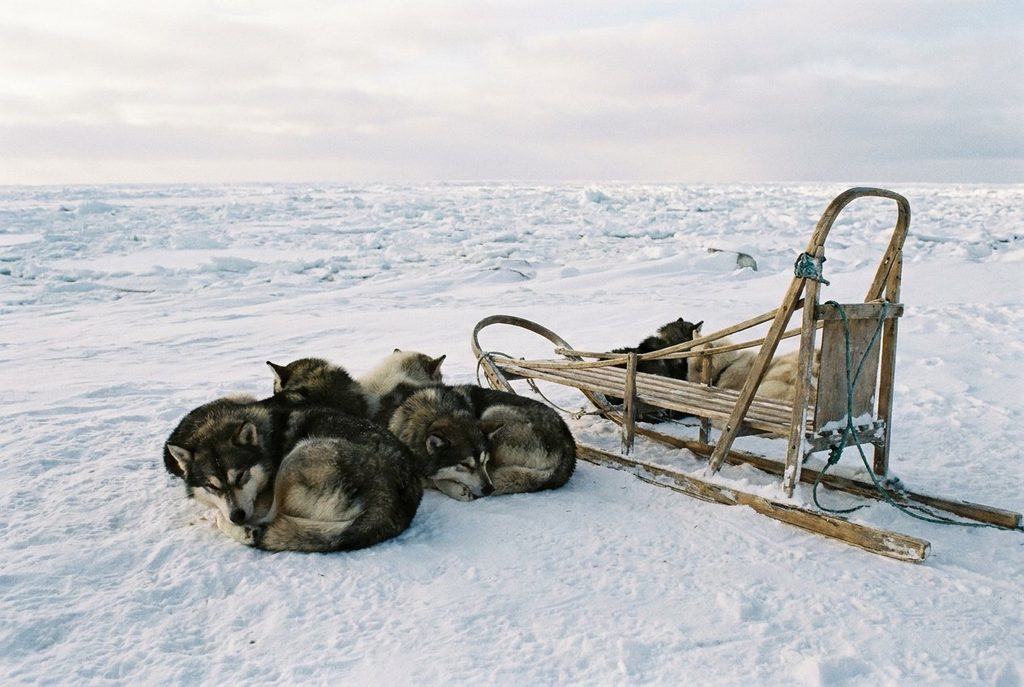
North of the Arctic Circle, the Greenland dog still pulls sleds across sea ice and snow. Learn how they live, when sledding happens, and how to behave around them.
| Daylight | Polar night through much of December; fast-lengthening days from February into spring. |
|---|---|
| Best months | February to April |
| Getting there | Flights to a town in the sled-dog district |
| Bring | Insulated boots, mittens, face cover, thermal layers, goggles |
For centuries, dogs made life possible across much of Greenland. They pulled hunters over the sea ice to reach seals, carried families between settlements in winter, and gave warning of polar bears. Snowmobiles and boats have taken over many of those jobs, but in the north and the east of the country the sled dog is still part of daily life. In towns such as Ilulissat you see them on the edge of every neighbourhood, and in late winter you can ride behind a team.
The Greenland dog
The Greenland dog is an old Arctic breed, closely related to the dogs that came with the ancestors of today's Greenlanders many centuries ago. It is strong, thick-coated and built for endurance rather than speed. A double coat keeps it warm at temperatures far below freezing, and dogs often sleep outside in the open, curled up with their tails over their noses while snow settles on them.
These dogs are not the same as the huskies bred for racing or as pets elsewhere. They are heavier, more independent and shaped by work. Each team has its own order, with some dogs leading and others following, and fights over rank are part of the life of the pack. Owners know their dogs well, and a good team responds to voice commands across the open ice.
The sled-dog district and its rule
Greenland protects its sled dogs with a firm rule. In the sled-dog district, which covers the country north of the Arctic Circle on the west coast and the settlements of East Greenland, only Greenland dogs may be kept. Other breeds are not allowed in. The rule exists to keep the working breed pure and to prevent diseases from reaching it. Below the line, in the south and around the capital, Nuuk, other dogs are common and sled dogs are not used.
For visitors, this means you should never try to bring a dog of any kind into the sled-dog district. The rules are strict and have been in place for a long time. If you have any doubt about the regulations, check before you go.
Dog sledding season
Sledding depends on snow and on sea ice, and both come and go with the seasons. Around Disko Bay the season usually runs from late winter into spring, once the days have lengthened and the snow is firm, and it ends when the snow softens and the ice breaks up. The exact months vary year to year with the weather and the ice, so check before you go.
→ Ilulissat, the town of icebergs
Short trips from Ilulissat give you a ride behind a local team over the snow-covered land around town, often with views over the frozen bay and the Ilulissat Icefjord. Longer trips of several days, with nights in huts or settlements, are offered in some places. Teams in Greenland are traditionally hitched in a fan, with each dog on its own line rather than in pairs, which suits open ice and snow. You sit on the sled and hold on; the driver does the work.
Polar night and the returning light
North of the Arctic Circle, winter brings the polar night, when the sun stays below the horizon for weeks. In Ilulissat this lasts through much of December and into early January. It is not total darkness: around midday a blue twilight lights the snow for a few hours, and the moon and the northern lights can be bright. Life goes on, but the dogs mostly rest and wait.
The return of the sun in January is marked by celebrations in many towns, and from then on the days lengthen fast. By March there is long, clear daylight, cold air and good snow, which is why late winter and spring are the best time for sledding. By late May the sun no longer sets at all, and the sledding season gives way to summer.
How dogs live through the year
Outside the season, sled dogs are kept on chains in yards on the edges of town, each with its own spot and often a simple shelter. They are fed by their owners, traditionally on fish and meat. In summer they spend most of the day resting, and their yards stay quiet except for chorus howls that start at one end of town and spread to the other. Puppies are often free to roam until they are old enough to work.
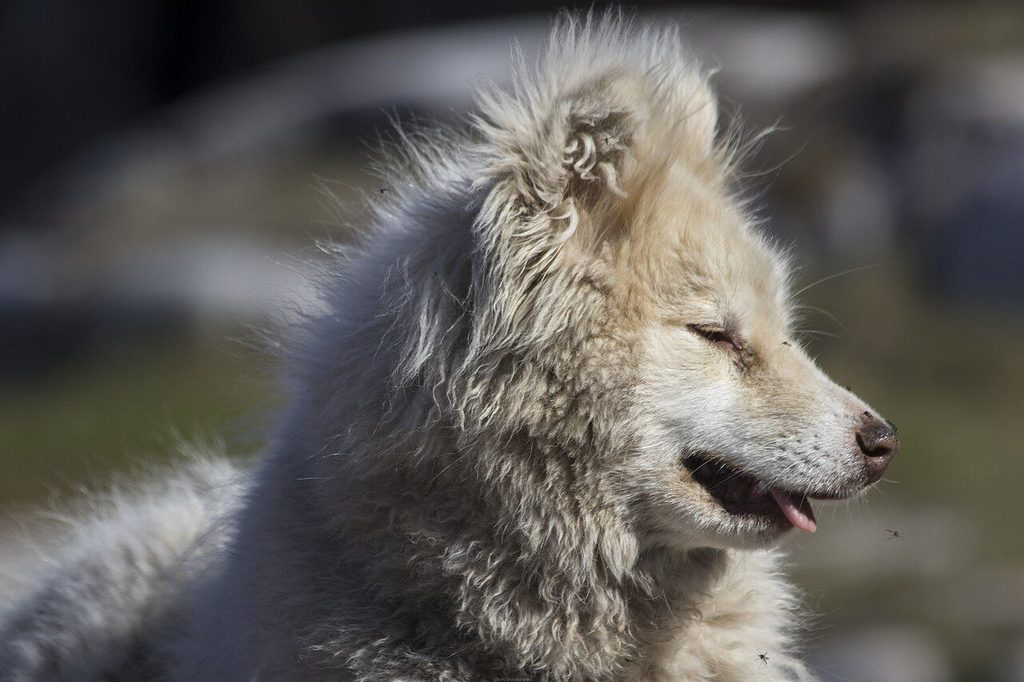
The number of sled dogs in Greenland has fallen in recent decades as snowmobiles, shorter ice seasons and the cost of keeping a team have changed life on the coast. In many places, sledding for visitors now helps keep teams working.
Manners around working dogs
- Do not approach chained dogs. Even friendly-looking dogs can bite if surprised.
- Do not walk between dogs in a yard or step inside the reach of their chains.
- Do not feed them, and keep food out of sight when you pass.
- Leave loose puppies alone unless the owner invites you to greet them.
- Ask before taking close photographs, and keep children by the hand.
If you visit a dog yard with an owner, let the dogs come to you and keep your movements slow. Owners know which dogs are calm with strangers and which are not, and their word is the rule.
On a sled trip, follow the driver's instructions, keep your hands and feet inside the sled, and dress for far more cold than you expect, since you sit still for long stretches. In summer, when sledding has ended, the same dogs rest while visitors take to the boats; our page on whales among the icebergs covers that season instead.